See the steps below to plan the right work for your roof.
Start with three facts you can check
Write down the site, the problem, and the work you want to discuss. These are three separate facts. A mailing address can help someone find a home. It does not prove which town has charge of permits. A wet ceiling shows where you saw water. It does not by itself show where water got in. A request for repair describes your goal. It does not prove which repair will work.
Keep those gaps clear in your notes. You can say, "I saw a new wet mark near the back room." You do not need to say, "The roof joint has failed." The first statement is a fact you know. The second needs a check by someone who can assess the roof. This small shift makes the project file much more useful.
Use a private project file for the street address and roof photos. Put the main question at the top. That gives each later note a clear purpose.
Know why City Hall is on the map
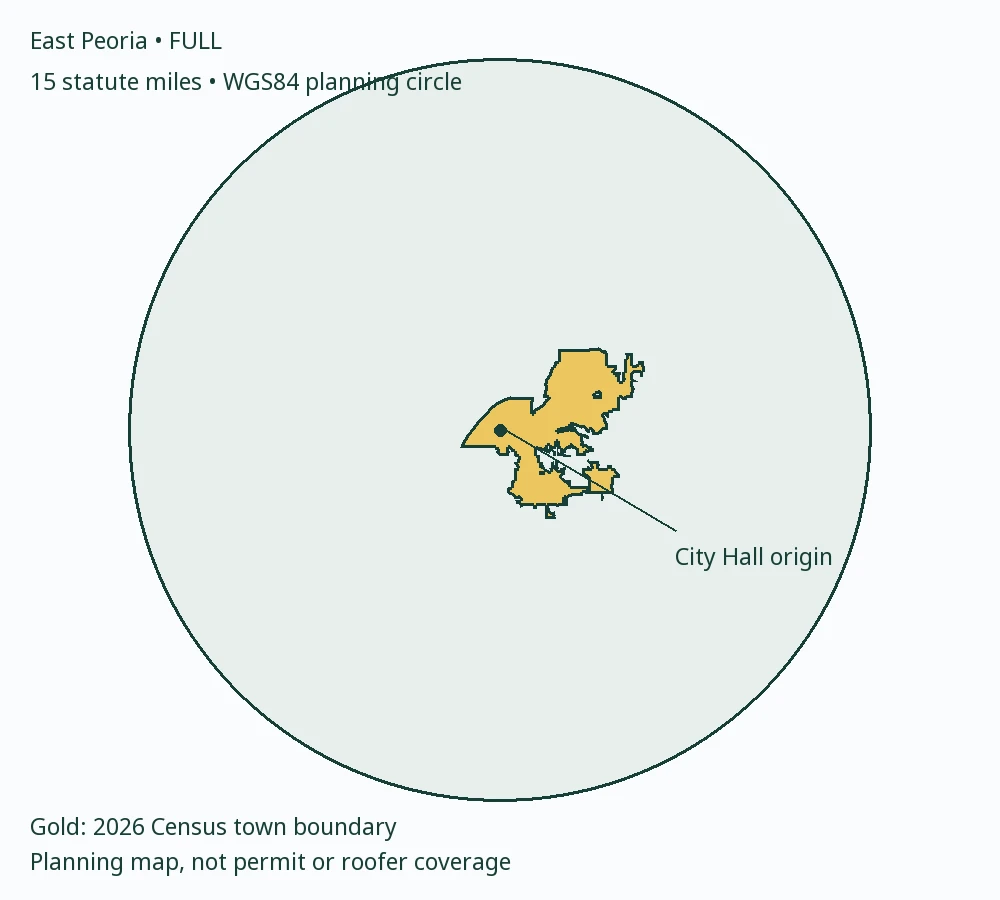
This page uses a circle with a radius of 15 statute miles. Its center is East Peoria City Hall at 401 W Washington Street. The city's own page confirms that public building. We use the point to draw a fixed planning map. The public building gives the map a fixed point that readers can check.
Our check of the 2026 Census town shape puts all of East Peoria inside that circle. This says where the town sits on the map. Ask each firm about the site, work, and terms when you compare your options.
The circle uses direct distance over the earth. A drive may follow a much longer route. Do not turn the map's 15 miles into a drive time. Do not use a town name or ZIP code as a test for a home outside the town line. If the address is near a border, keep its permit office as an open question until the right public office confirms it.
East Peoria in the planning circle
- 1Town polygon
East Peoria is fully inside the 15-mile planning circle.
- 2Exact site
Check the parcel; mailing labels do not set jurisdiction.
- 3Roofer coverage
Confirm whether the roofer handles this property and scope.
Find the city route before you fill a form
East Peoria's Residential Permits and Development Requirements page names the Inspections Department. It links the city's online building permit form. It also points readers to rules for permits and inspections. Use that official page as the first route for a home within the city. It was checked on October 8, 2026.
The page is not a roof ruling for your house. Describe the actual work before you ask whether a permit is needed. Say whether the plan is a small patch, new roof cover, work on wood below it, or a change to the roof shape. If you do not yet know, say so. A short, honest scope helps the office tell you what it needs.
Make a note of the date, the office, and the answer. Ask how to keep that answer with the project file. Read the permit and property-jurisdiction page for more help with town lines. Here, the key task is to keep the city answer tied to the same scope that a firm will price.
Build an address-to-scope card
Use one sheet with four boxes. The first box is for the site. Keep the exact address and parcel number in your own file. The second is for the office that will review the work. Leave space for the date and the source of that answer.
The third box is for the roof problem. Give each spot a plain name, such as "back room mark" or "garage roof edge." The fourth is for proposed work. Copy the firm's exact scope into that box once you have one. Avoid trying to shorten it before you understand what it includes.
This card can reveal a mismatch early. The city may have answered a question about shingles alone. The estimate may now include roof framing. Or the estimate may cover the house while your notes also describe the shed. Circle the gap and ask again. Do not treat an answer about one task as an answer about all tasks.
- Site box: Which land parcel and which building are we discussing?
- Office box: Who confirmed the permit route, and for what work?
- Problem box: What did I see, and when did I first see it?
- Scope box: What will the firm do, and what is left out?
The four-box project card
- 1Site
Record the exact address and parcel.
- 2Office
Confirm the authority that handles this property.
- 3Concern
State what you saw without guessing the cause.
- 4Scope
Save the current work list and its date.
Tell Us About Your Roof
Tell us what needs attention.
Record changes from a safe place
Take notes from a safe room or from the ground. Do not go onto the roof to complete this sheet. If part of a room seems unsafe, stay out of it. A record is useful only when you can make it without harm.
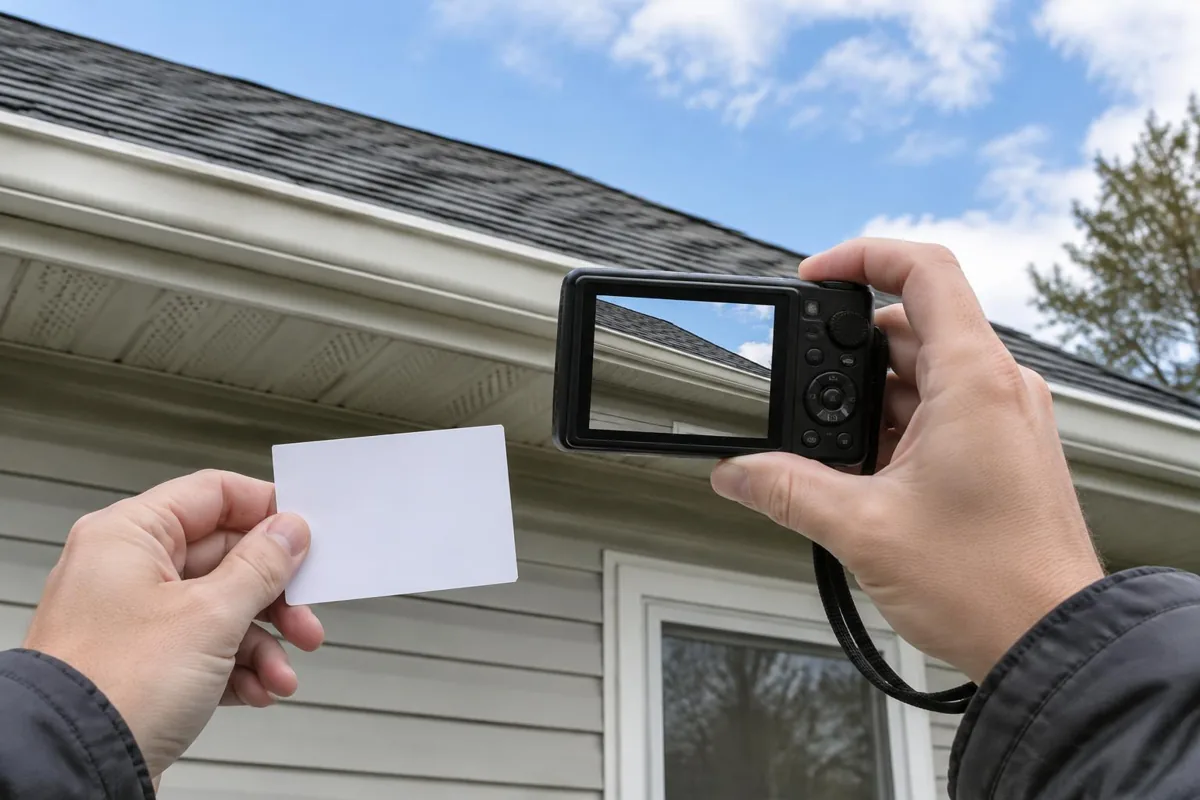
For each mark or leak, note the date and what changed. Was it dry before? Is the same spot wet again? Does the mark seem larger in a photo taken from the same safe place? Keep the first photo as well as the new one. A set of dated views is easier to follow than one close photo with no context.
Give each photo a short label. "Back room, wide view, Tuesday" is enough. Add one view that shows where the spot is in the room. Then add a closer view if it is safe. Keep guesses out of the photo name. A file named "bad flashing" can make a guess look like proof.
The roof inspection page explains what a written roof check can include. Use it to ask for findings, limits, and next steps. Your own log gives that check a clear starting point.
Match each question to the right person
The city can address its permit process. A roofing firm can explain its proposed roof work. A product maker can explain its own product terms. These roles may touch the same project, but their answers have different uses. Keep a separate line for each answer so they do not blur together.
For example, ask the city which parts of the plan need review. Ask the firm how it will address the area you marked in your log. Ask who will seek any needed permit and who will keep proof of the final result. Do not assume that an estimate includes those tasks because it has a single total.
If one answer depends on another, write down the link. A firm may need more detail before it can name the full repair. The city may need that detail before it can answer a permit question. Mark the item as open. An open item is more useful than a guessed answer that no one can trace later.
Read an estimate against your card
Set the estimate next to the four-box card. Start with the building name. Is the work for the house, garage, porch, or more than one roof? Next, find the problem spot. Does the scope name that area in terms both you and the firm understand?
Then find the work limits. Ask what will be removed, kept, and added. Ask which nearby parts will be checked. If work on hidden wood may cost more, ask how that extra work will be shown and approved. Do not fill in a missing term with what you hope the firm means.
Read the roof repair page when you need more detail about repair scope. This local page helps you keep those details linked to the right site and city answer. The goal is a file in which each fact supports the next step. You should be able to trace the path from your first note to the written plan.
Try a simple mismatch test
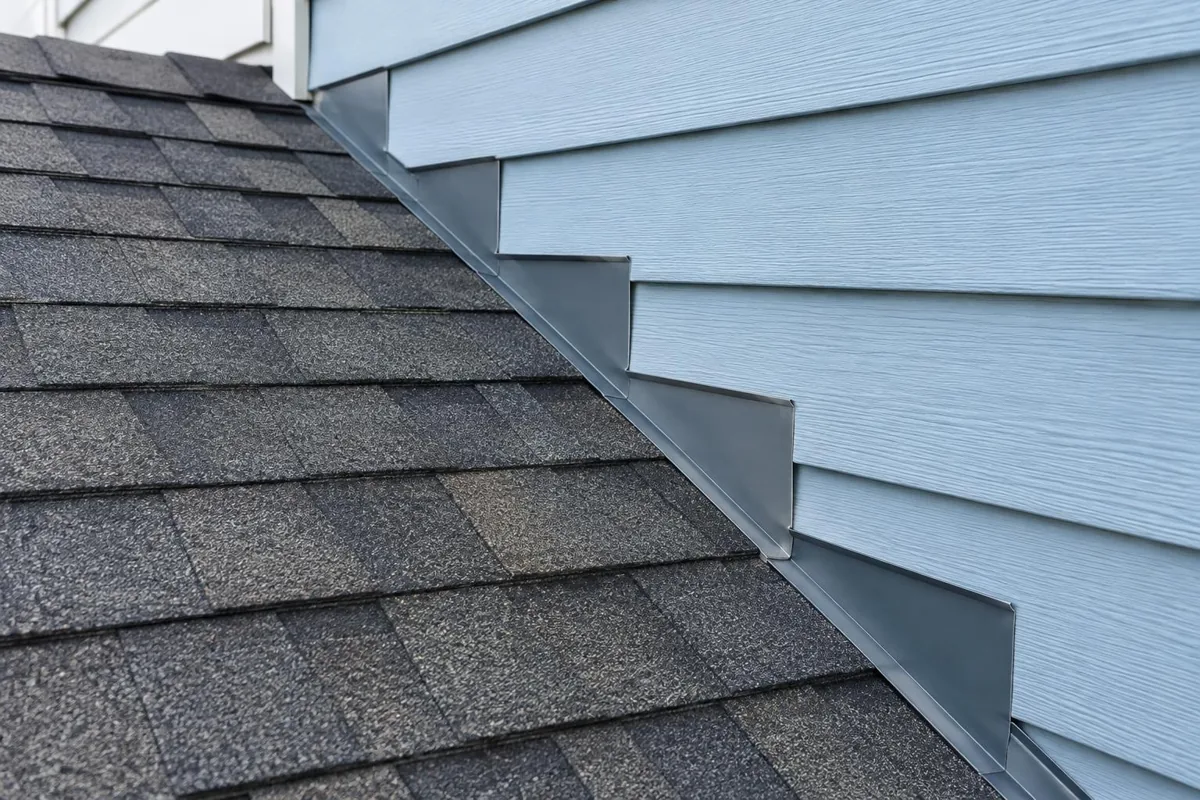
Here is a made-up planning example. A homeowner sees a drip near a back wall. Their first note asks for a shingle patch. A later roof check calls for work at a wall joint too. The old city question still says "shingle patch." The new estimate says "roof and wall work."
The next step is to update the scope question. It is not to guess that the first answer still fits. Ask the firm to state the added work in plain terms. Use that new text when you seek a project-specific answer from the public office. Keep both versions so you can see what changed.
This test is useful even if no permit is needed for the final job. It helps catch work that has grown beyond the first plan. It also gives you a fair way to compare firms. Ask each one about the same set of tasks. A smaller total may cover less work rather than a lower price for the same work.
Tell us where the leak, wear, or damage needs attention.
Keep a short change record
Give each scope a date. If a firm sends a new one, keep the old one but mark it as replaced. Write a one-line note on the change. For example, "The garage is now included," or "Wood work is priced as an extra item." Do not rely on memory to sort out similar files.
Before work starts, ask which written version will guide the job. If the work changes after the roof is opened, ask for a clear record of that change. The record should show what was found, what is proposed, and how cost or timing may change. Ask how you will approve it before that added work proceeds.
Keep proof of any required permit steps with the same version. This does not turn your folder into a city approval. It simply makes the project easier to follow. Later, you will not need to guess which roof plan went with which note from the office.
Choose the next useful step
If the location is unclear, check the parcel and ask which office serves it. If the roof problem is unclear, prepare the safe photo log for a roof check. If the scope is unclear, ask the firm to fill the gap in writing. Choose the smallest step that resolves the main open question.
Once the plan is clear, use the choosing-a-roofing-company page to review the exact business and its written terms. A good project record supports that choice. It cannot prove a firm's skill or make a poor scope sound complete.
Keep your final sheet brief enough to read at a glance. Put extra photos and long notes behind it. The front sheet should show the site, office, problem, and current scope. That front sheet can guide your next call or help you compare written answers.
Roof Repair in East Peoria, IL: the key steps
Read the full transcript
Roof Repair in East Peoria, IL.
East Peoria City Hall sets the map center.
Its 15-mile circle gives this page a fixed planning area.
For a city home, start with East Peoria Inspections.
Ask about the exact site and planned work.
Keep site, office, problem, and scope in four boxes.
A missing answer stays open until checked.
If the work grows, update the permit question.
An old answer may cover only the old plan.
Compare the current written scope with your notes.
Resolve gaps before you choose a firm.
Your questions, answered.
Why does the map start at City Hall?
East Peoria City Hall gives the planning circle a fixed, verifiable center. The radius is 15 statute miles by direct map distance. Use that same center when reading the town map.
Can I use the mailing city to pick a permit office?
Treat it as a clue. Confirm the parcel and actual town line with the public office. A mailing label alone cannot settle who reviews work at the site.
What if I have not chosen a repair yet?
Tell the city that the scope is still being checked. Keep the question open. Once a firm gives you a clear plan, ask about that plan and save the answer with it.
Which photos should go first in the project file?
Start with a safe wide view that shows the spot in context. Then add a closer view if you can take it safely. Date both and use plain labels that avoid guessing the cause.
What is the most useful item to finish today?
Complete the site and problem boxes. Then mark the biggest missing fact. You can seek the right office or prepare for a roof check without guessing the final repair.