Start with the roof you already have
No single roof material is best for every Illinois home. Start with the roof's slope. Check its support and shape. Note its current state. Think about the work you want done. Then compare the right options against your own needs. A material may look good on a sample board. It still must fit the whole roof.
If you are replacing the roof, ask for clear system options. Maybe the real concern is a small leak or a few bad pieces. If so, name that repair first. This page helps you compare choices once the work is clear. It does not turn every small roof issue into a full replacement.
Set your limits before you score preferences
Some questions cannot be traded for a nicer color or a lower price. The installer must confirm the system fits the roof's slope and support. A material change may need a closer look at the frame or at roof joints. Keep any open fit question as a hold in your worksheet.
Use the property address to find who handles permits and design approvals. The City of Peoria permit page is a good start for city properties. A Peoria mailing address alone does not prove which office is in charge. Ask who checks this. Ask what must be settled before you order material.

Compare whole material systems, not just looks
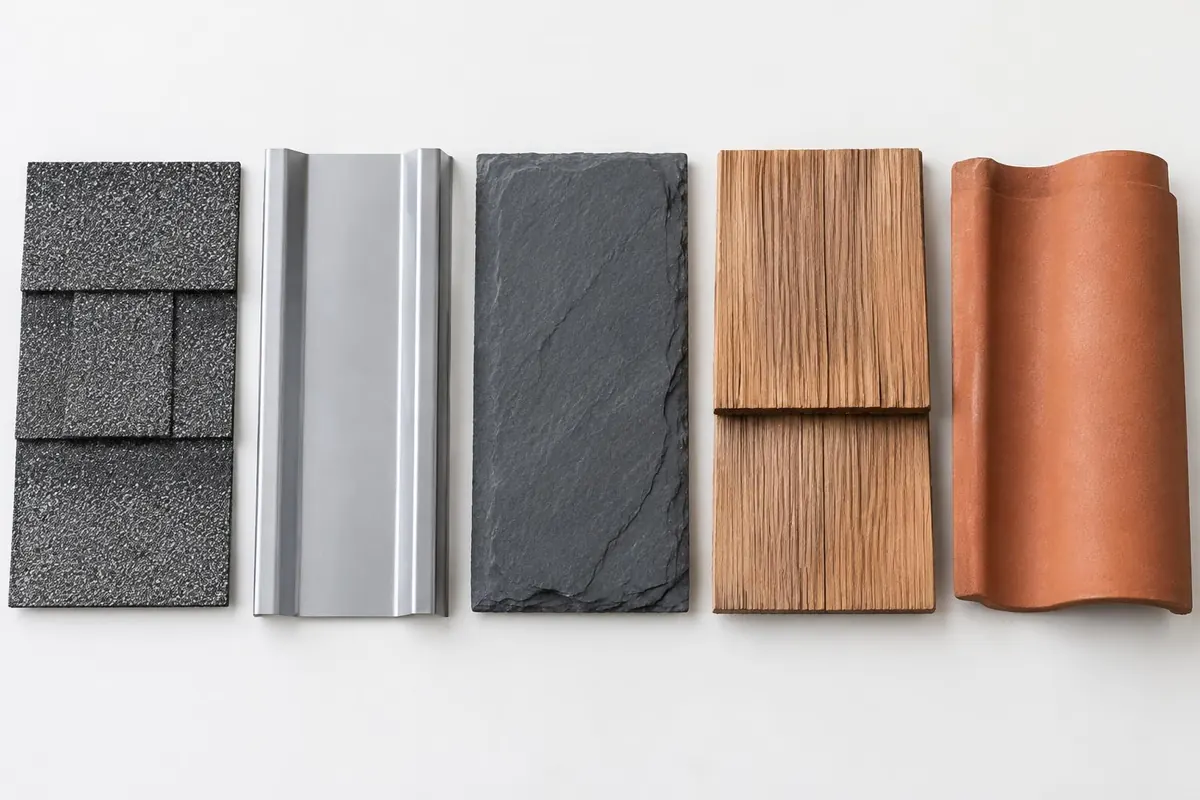
For asphalt, compare the named shingle, underlayment, starter, flashing, and ridge parts. For metal, note the panel type, the attachment type, and the finish. GAF's roof-parts guide and Sheffield's panel guide show that looks are only part of the choice.
For an existing slate, cedar, or tile roof, ask for a condition check suited to that material. Do this before you assume it needs replacing. Keeping sound parts may be an option. But it needs real proof. Keep natural materials and look-alike products named clearly apart. A similar look does not mean the same install steps, support needs, or warranty.
Your priorities, your evidence
- Set a weight from 0 to 5 for each priority
- Name each roof system you are weighing
- Mark fit: confirmed, hold or unknown
- Rate each priority from 1 to 5
- Only confirmed, complete options get ranked
Every number comes from you. The score shows preference, not technical fit.
Pick the priorities that matter most to you
Choose a few goals you can explain. These might be looks, the price in the written bid, upkeep you can manage, and clear warranty terms. Decide what matters most before you look at any score. If a historic look matters a lot to you, say so directly. Do not hide it in a low-weight spot.
Use real samples to judge looks next to the parts of the house that stay. Use real quotes for cost. Use written guidance for care needs. Do not give a material a high score just because someone promised a fixed lifespan. Ask which facts are written down. Ask which are just opinions.
Roof material decision matrix
Stays on this page only. Nothing is sent or saved.
Keep price and future care as separate items
Compare full installed totals for the same roof area and the same work. GAF lists size, slope, and job complexity as things that affect a roofing estimate. A material-only price will miss work like removal, deck repair, flashing, and haul-away. Use the quoted total. Do not use a guessed local rate.
For upkeep, ask what checks and tasks the chosen system needs. Ask who can do them. Keep those duties clear, even if a future price is unknown. You do not need a guessed lifetime cost to make a good choice today. A clear starting cost plus a care plan gives a more honest comparison.
Request help choosing a roof material in Peoria
Tell us what needs attention.
Read product claims without adding meaning
A test rating, a product warranty, a workmanship promise, and an insurer's reply are four different kinds of proof. Keep them in separate boxes. GAF says a lab result does not promise hail protection. It also says an insurance discount is never a sure thing. Do not let one badge answer all four questions.
The same care applies to big words like lifetime or maintenance-free. Ask what the written terms really say for your chosen product. Write down key exclusions and any owner duties. If a claim matters a lot to you, settle it first. Then give that option a score.
Set your own weights and give your own ratings
The decision tool lets you set a weight from zero to five for each goal. You then rate each option from one to five. Use your own facts and views. It works out the weighted average. It shows how each number was used. The site gives no hidden material score or winner.
A blank rating stays blank. An open fit question puts that option on hold. This happens even with a high score. If every weight is zero, the tool asks you to pick a goal. Try changing one weight. See if the result holds steady or swings a lot.
Turn your comparison into a roofing request
Pick the two options worth a closer look. List the questions that could change your mind. Ask the roofer to confirm roof fit. Ask for matched scopes. Ask to see real samples. You can add your worksheet summary to the local request form if you choose.
A close score is not a problem. It can mean both options meet your needs. Or it can mean you need more facts. Use the result to guide a talk. Do not use it to override an open technical question. A good outcome is a roof plan you can explain, with the work, product, and open items clearly stated.
Your questions, answered
Does the tool pick the strongest roofing material?
No. It has no built-in strength or lifespan ranking. It sorts your priorities and the facts you enter. Fit for your roof must be checked outside the score. Unknown technical issues stay on hold.
What if I only care about price?
You can set price as the only weight that is not zero. First, compare full installed quotes. Fit questions and open scope items still need answers. A low price score does not approve the roof design or erase hidden work.
How should I rate upkeep?
Use the written care guidance for the chosen product and the work you can really arrange. Write down why you chose that rating. If the needs are unknown, leave the field blank. Do not assume a material needs no care.
Can a high score cover for an unknown support need?
No. The worksheet holds any option with an open fit question off the ranked ready list. Ask a qualified roofing or structural professional to settle that question first. Only then treat the option as ready to pick.