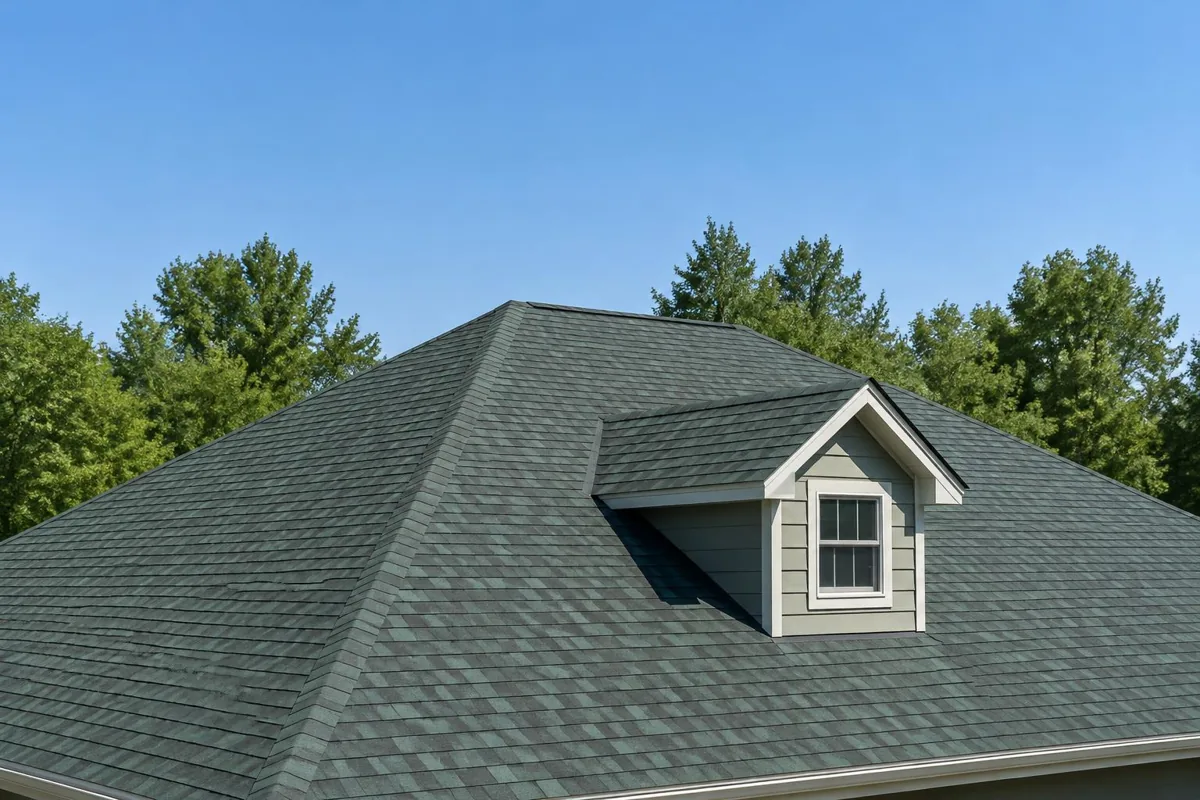
See the steps below to plan the right work for your roof.
Read the partial map label correctly
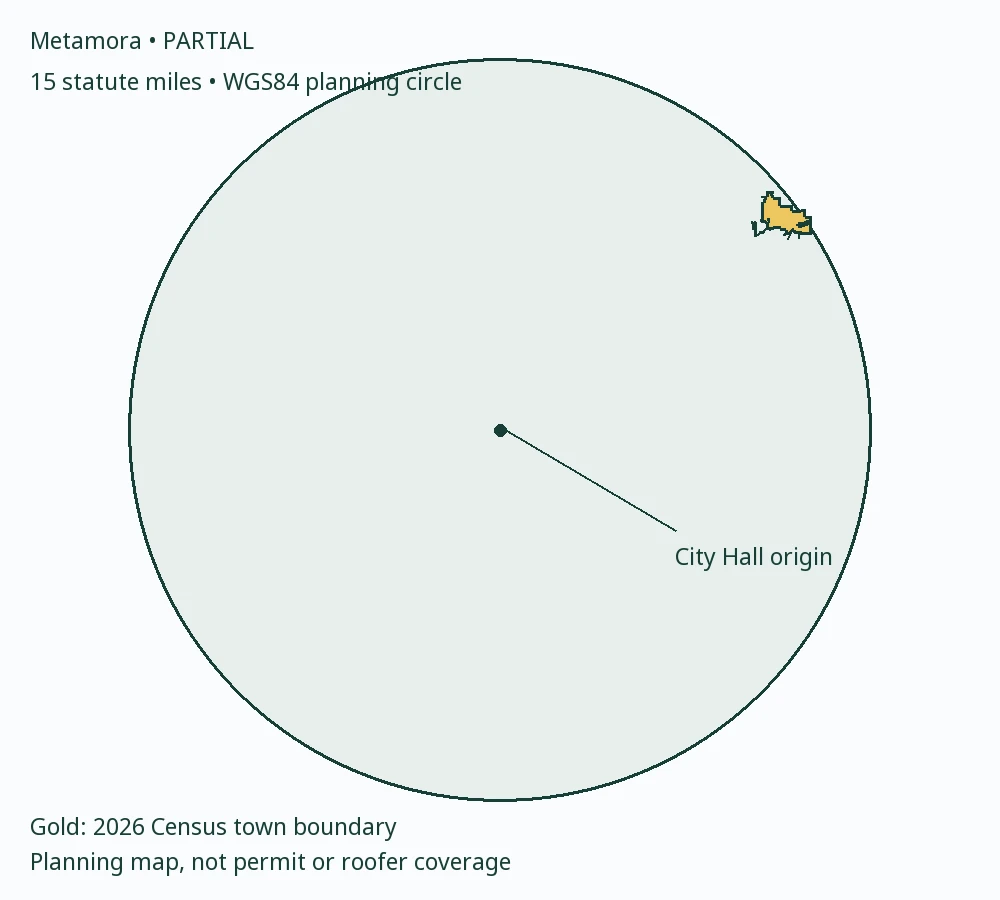
Metamora is marked PARTIAL in this page's planning map. The circle extends 15 statute miles from East Peoria City Hall. We checked the 2026 Census village shape. The farthest point on Metamora's edge is about 15.276 miles from that center. So the full village does not fit inside the circle.
That number refers to the farthest point on the mapped village edge. It is not the distance to your home. It is not a drive distance or a roofer's travel limit. It cannot tell you whether an exact roof is inside the circle. A town's center would not settle that question either.
The circle defines the area used for this page’s planning work. Use its fixed center and direct distance when reading the map. Then check the separate permit and project questions for the actual site.
Metamora crosses the planning-circle edge
- 1Planning circle
Metamora is PARTIAL: its polygon crosses the 15-mile boundary.
- 2Permit jurisdiction
Confirm the parcel and responsible authority.
- 3Roofer coverage
Ask separately whether the roofer can handle the job.
Use a three-answer location card
Make three lines on a sheet. The first asks whether the site is inside the page circle. The second asks which public office reviews the work. The third asks whether a chosen roofing firm will review this exact job. Give each line its own answer and source.
The first line may not affect your next step. If so, it is fine to leave it unknown. You can still prepare a repair question and use official permit guidance. Do not change unknown to yes. A map label that names Metamora is not enough proof.
This card can prevent a common mix-up. A roofer's willingness to visit a home does not prove the permit route. A public office's reply does not make the roofer available. Each answer should stay attached to the question it actually resolves.
- page circle: Is the exact site inside the defined map, or is that still unknown?
- Public office: Which office confirmed the parcel and planned work?
- Firm acceptance: Has the firm itself agreed to talk about this site and scope?
- Source note: Who gave each answer, on what date, and with what limits?
Three questions with three answers
- 1Planning answer
Record whether the exact site is inside the circle.
- 2Jurisdiction answer
Record which office handles the site and scope.
- 3Coverage answer
Record the roofer’s own capacity for the work.
Start the village question at the official page
Metamora's Building Permits and Zoning page directs permit questions to the Village Zoning Administrator. It links building and construction ordinances, zoning rules, and village maps. The page was checked on October 8, 2026. It is a helpful starting point when the site falls within the village.
The page does not show a roof exemption for every project. Describe the planned work and ask what applies. The site may be outside the village. Ask which public office should get the question. Do not apply the village's process to an unincorporated site without confirmation.
Use the village map to learn about the area. Check more closely when a site is near a line. A line on a small screen may be hard to read at parcel scale. Ask the office to confirm the site when the answer is unclear. Keep that reply with your project notes.
Tell Us About Your Roof
Tell us what needs attention.
Be precise when the site is near an edge
A map near a line needs careful reading. Check what the mark represents. It may be a town label, an address point, a building, or a whole parcel. Those are not interchangeable. A label can be centered far from the real roof you want to talk about.
One marker may appear inside a line. That does not prove the whole site is inside it. If the distinction matters, seek a reliable place check for the exact site. Keep the method and date with the result. This page's town classification comes from village geometry, not from private address checks.
Avoid using driving directions as the radius test. Road distance answers how far a route travels. The planning circle uses direct distance over the earth. A route can be longer for reasons that say nothing about the circle. The two measures should not be compared as if they used the same path.
Use your own records and official sources for the site question. Keep exact address details in your private file. Mark an uncertain map result so it remains easy to spot.
Build an estimate-ready brief after the location check
Once the site and public route are clear enough, prepare a short roof brief. Name the building involved and the problem you observed. State when you first saw it. Add a safe photo if you have one. Leave the cause unknown unless a qualified assessment has shown it.
Describe your goal in plain terms. You may want to find a leak's cause or repair one spot. You may want to compare repair with broader work. These are questions to assess. They are not proof that one exact solution fits the roof.
Ask the firm what it needs before it can give a helpful plan. If it needs a site visit, confirm the scope and terms with that firm. Keep any appointment details in your own records.
The roof inspection page can help you ask for clear findings. Use it to review which roof areas were checked. Note which could not be seen too. Settle the site question first. Then use that evidence as the next input to a scope.
Ask each firm about the actual site
You may choose to contact a roofing firm. Do not rely only on its broad service-area map. Ask whether it will review your exact address and type of work. A firm sets its own work area and project types. This page cannot know those limits.
Ask whether any site-related terms affect the estimate. Do not guess there is a travel fee, and do not guess there is none. Such a charge or condition may apply. Ask the firm to state it in writing. This page gives no local fee estimate or price range.
Also clarify which buildings and roof sections the firm is talking about. An agreement may cover only the house roof. Do not assume it includes a detached structure. If your brief has more than one building, name each one. Keep the same building labels in the photos, report, and estimate.
Read the choosing-a-roofing-company page for the business checks that come next. A firm's willingness to visit is only one fact. It does not show credentials, scope quality, or a good contract.
Test two boundary mistakes
Here are two made-up examples. In the first, a house lies within Metamora but outside the page circle. The owner can still use the roof guides and comparison sheets. For permit questions, the site’s village boundary matters. For a roofer visit, the firm's own acceptance matters. The page circle does not decide either answer.
In the second example, a home uses Metamora for mail but lies outside the village. It might be inside or outside the circle. The owner asks which office serves the real parcel. They do not treat the village page as a final ruling. Again, the map and the public office are separate questions.
These are examples, not real sites. Each answer needs its own line. Do not turn all three into one yes or no. That could imply more than you know. Keep the exact answer with its source and the job becomes easier to plan.
Tell us where the leak, wear, or damage needs attention.
Turn findings into a comparable roof scope
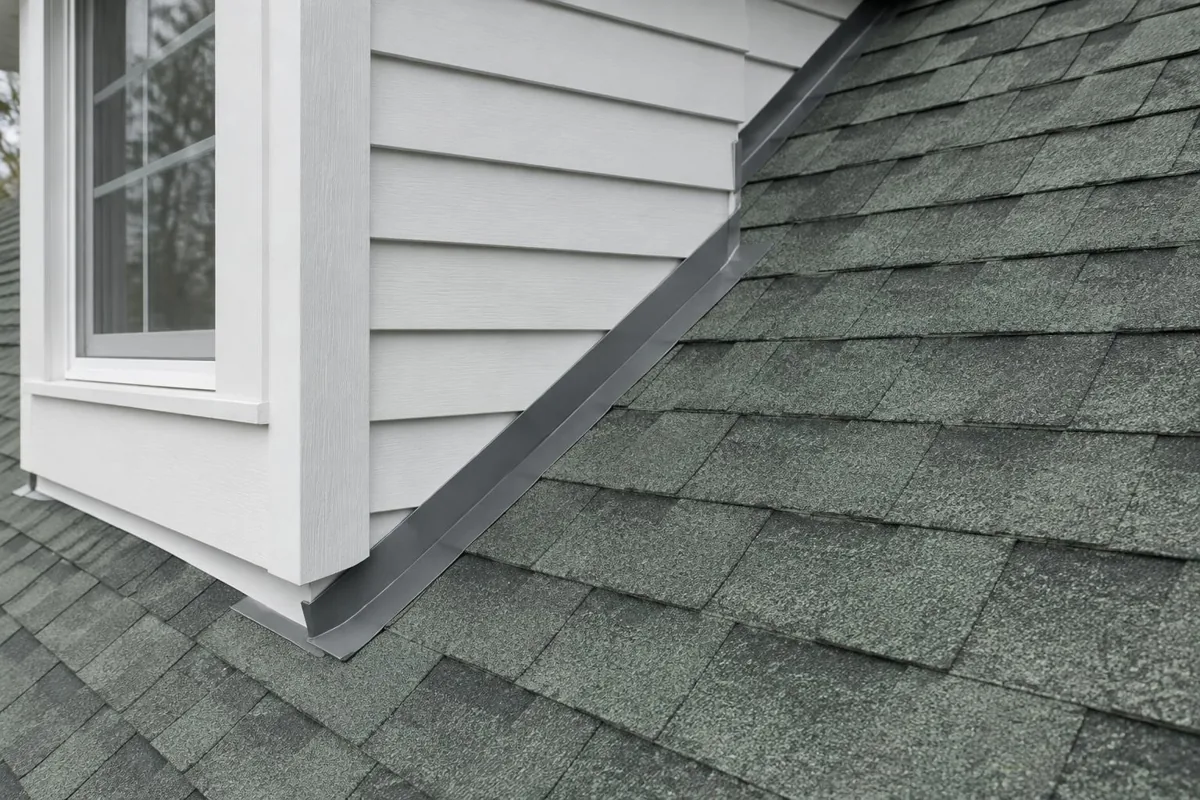
After a roof check, ask for the work limits in writing. Which area needs attention? What will be removed? What will stay? Which adjacent details are included? Ask the firm to connect those tasks to the findings in its report.
The roof repair page gives a deeper set of scope questions. Use it rather than treating a local place page as a technical repair manual. Add three things to your Metamora file. Name the site, the office, and the firm's agreed role. Keep these beside the roof questions.
If new work appears, revisit the public-office answer. Your first question may cover a small repair. Later work on support or a second building may need a new answer. Give the office the updated scope and ask what changes. Keep both versions so you can trace the sequence.
When two estimates differ, name the tasks that differ before comparing totals. A broad area label does not make two roofing firms' offers alike. The written work, terms, and evidence are what you need to compare.
Close both the location and project records
At the end of planning, look at the three-answer card again. The page-circle line may stay as a general map note. It may not have been needed for the job. The public-office line should reflect the office in charge of the real work. The firm line should reflect what the chosen business has agreed to do.
Keep any required permit and inspection results with the project file. Metamora's official page describes inspections and a compliance certificate for finished projects that required permits. Ask the village what closeout records apply to your scope. Do not infer a final status from a form being submitted.
Save the done work account and any later scope changes too. This gives you a clear record for future questions. The goal is not to make a site fit a circle. Use the right facts for each choice. Prepare a roof plan with clear limits.
Roof Repair in Metamora, IL: the key steps
Read the full transcript
Roof Repair in Metamora, IL.
Metamora only partly fits the page circle.
The farthest mapped village edge is about 15.276 miles from the center.
Map fit, permit authority, and contractor acceptance are different questions.
Keep a separate source for each answer.
Metamora directs permit questions to its Zoning Administrator.
Confirm the actual parcel and work before applying village guidance.
A town label cannot locate a roof.
Ask each chosen firm about the actual site and proposed scope.
Use findings to define the work.
If the plan changes, check whether the earlier permit answer still fits.
Your questions, answered.
Is all of Metamora inside the 15-mile circle?
No. The village shape is partial. Its farthest mapped edge is about 15.276 miles from East Peoria City Hall. That town-level result does not locate an individual site.
Can I use this page if my home is outside the circle?
Yes. Use the roof guides and planning sheets for the questions they help answer. Confirm the public office for your actual property and ask each chosen firm about that site and scope.
Does a Metamora ZIP code mean the village issues my permit?
No. Confirm the real parcel and public office. A mailing label does not prove the village line. It does not name the office that reviews the work.
Which map should I show a roofer?
Use the exact site guidance and a clear roof brief. Ask the firm whether it accepts that address and scope. This page map cannot stand in for the firm’s own consent.
Why keep an unknown answer on the location card?
An honest unknown shows what still needs checking. A guess can send a permit question to the wrong office. It can imply service that no firm has agreed to give. Resolve only the questions needed for the next step.