See the steps below to plan the right work for your roof.
Put each question with the right person
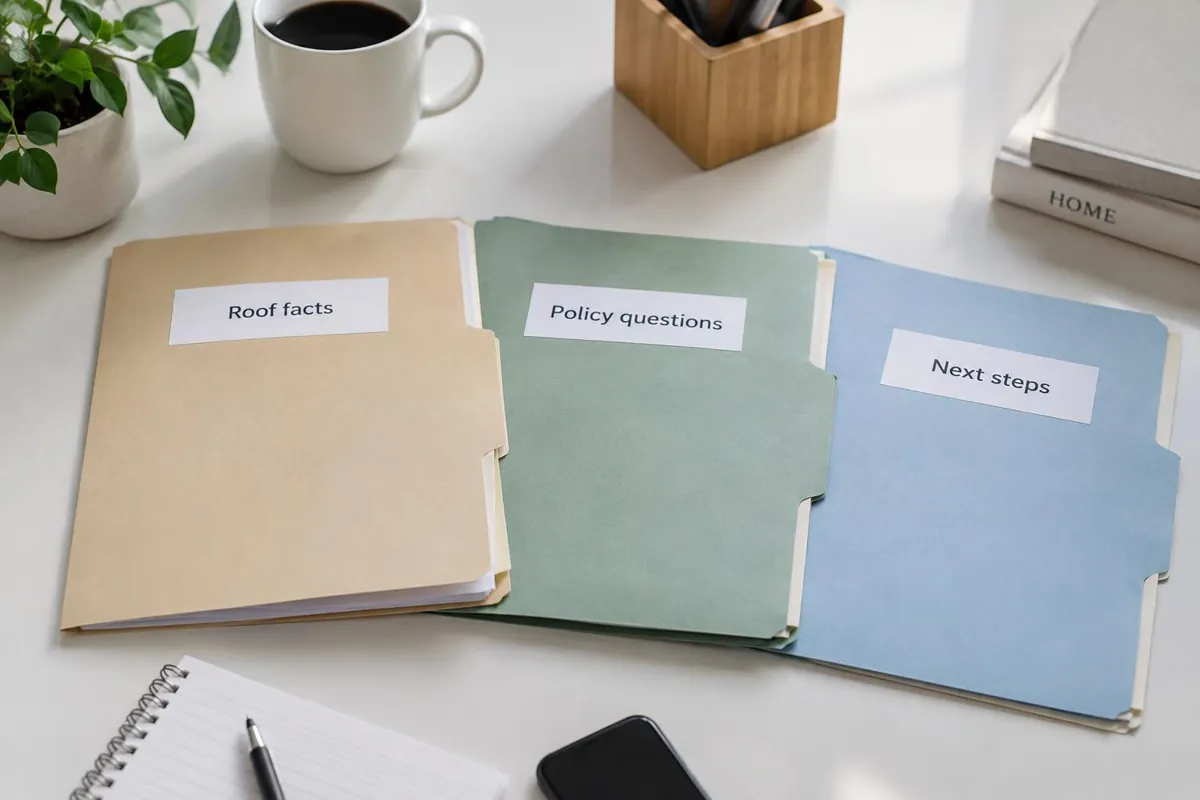
Start two lists. The first is about the roof. What was found? Where is it? What work would fix it? The second is about your policy. What terms apply? What proof is needed? Who can explain the answer? A roof report may help show the facts. It does not promise that a claim will be paid.
Ask whom each person works for and what they do. Keep that answer with their name. The word adjuster does not mean that a person works for your insurer. A roof sales contact has a different role, too. When someone offers help, ask what that help includes. You should know who is speaking before you rely on what they say.
Send each question to its right role
- 1Roof work
Ask the roofer about findings, safe repairs, and written scope.
- 2Policy terms
Use the verified insurer contact for coverage and claim decisions.
- 3Legal rights
Ask a qualified attorney for legal advice; no payout promise follows this map.
Use a known route to your insurer
Find the contact route in your own policy papers. You can also use the insurer's official site. Ask which team should take your roof question. If you have a claim number, keep it ready for that call. There is no need to type it in a public form. A simple list of roof bids does not need it either.
Write down who takes the call and how to reach them again. If the call is passed to a new team, note that. Ask who owns the next step. Keep your own copy of each paper you choose to share. Use a route you can check before you send a private file.
Describe what you saw, not a guessed cause
Keep your first account brief and factual. State where you saw the problem and when you first saw it. Say what is visible from a safe place. If a roofer has made a report, keep it close at hand. Your own notes and the roofer's findings should stay distinct. A storm alert alone does not prove what harmed a roof.
Use the storm record page to put events in date order. If you do not know when damage took place, say so. Do not use the last storm date just because it seems to fit. A date you know and a date you think might fit are not the same fact. Keep that gap clear.

Ask which policy papers apply
Ask your insurer which policy and forms apply to the roof question. Ask it to point to the text it uses. Request a plain answer if a word or clause is hard to read. An endorsement is a change to a policy. The state has a terms page that explains this word. Ask whether such a form affects your question.
Keep the pages named in the answer together. A short summary may not hold all the terms. If two people name different pages, ask why. Do not decide on your own that one page cancels out the other. An Illinois lawyer can review the clause and give legal advice on your own papers.
Tell Us About Your Roof
Tell us what needs attention.
Ask how the deductible is set
A deductible is the part of a claim assigned to you. Ask which one applies under your terms. Is it a set dollar amount? Is it a percent? Does a special roof or storm rule apply? The state's claim page explains that these forms can differ. You need an answer about your own terms, not a guess from a chart.
If the rule uses a percent, ask what it is a percent of. Do not assume that it is based on the roof bid. Ask for a written example that fits your policy. Keep the answer in your private file. Use only the rule confirmed for your own policy when you review the math.
Ask what each amount means
The state page defines actual cash value as replacement cost less depreciation. The last word means loss of value from age or wear. Ask which value basis applies to the roof work. Ask where the terms explain it. Do not treat two value labels as if they mean the same thing. Have your insurer explain the difference in plain words.
A claim paper may show more than one amount. Ask what each one means. Is it a work estimate? A payment now? A possible later amount with steps still to meet? What has not been decided? Keep those answers next to the figures. A number printed on a page is not always money you can use now.
Make a list of dates to confirm
Ask what dates apply to your next steps. For each date, ask what must be done by then. Ask where the rule is written and what counts as meeting it. If you need more time, ask about that process. This page sets no filing date. It cannot give you more time or tell you that a deadline does not apply.
Put each date beside its task in your notes. Include the time zone if a time is given. Keep the source of the answer. A reminder may help, but it is not the rule itself. If you send a file, ask how to check receipt. A sent file and a complete file may be two different stages.
Keep a short call log
After a call, note who answered and what you asked. Write down the answer while it is fresh. Add what still needs a reply. If an answer affects a major choice, ask for it in writing. Use the same verified route for that request. You do not need to rely on a long chain of memory.
Make one row for each issue. Put a date on it. Keep firm answers apart from things someone will check later. If an answer changes, add a new row. Do not erase the old one. The log helps you track the question. It does not prove that every statement made on the call is true or settled.
| Question | Record the answer | Leave open until confirmed |
|---|---|---|
| Who handles this issue? | Team and verified route. | The right person to follow up with. |
| What document applies? | Policy section or written source. | Any conflicting wording. |
| What is the next step? | Task, owner, and exact date. | Whether receipt or completion is confirmed. |

Tell us where the leak, wear, or damage needs attention.
Ask about urgent protective work
Deal with an immediate threat to life through emergency services. Do not wait for a web page to settle a dangerous roof issue. For the policy side, ask your insurer about urgent protective work. What facts does it need? What records does it ask for? Who should you reach if your usual contact cannot be reached?
Ask a qualified roofer about the work needed now. Have it state the purpose and limits of any short-term step. Keep that separate from a full new-roof plan. The urgent roof page helps with the safety questions. This page cannot tell you what a policy will pay. Nor can it approve work for the party that holds your policy.
Keep records in a private file
State disaster guidance points to good records and contact with your insurer. Keep dated photos, roof reports, receipts, and key messages in one place. Save the original files when you make a smaller copy to send. Do not go onto a roof or into an unsafe space to get a better photo. A missing view can be noted as missing.
Before you share a file, ask what is needed. Check the route it will use. Leave out private details that do not serve the task. Keep account and policy numbers out of public albums. Use the blank question list with simple topic labels. Leave names, numbers, addresses, and private claim details in your own file.
Read a roof bid for its work scope
The roofer's bid sets out proposed work and price. Ask which areas it covers and which parts it leaves out. Ask how added work would be shown and priced. Use the new-roof cost page for a broad project. Use the repair cost page for a smaller one. A bid is not a promise of claim funds.
If two scope lists differ, name the exact gap. Ask each party to explain its own list. Which roof area or task is in dispute? Is a fact still missing? Do not merge the lists and call the result approved. Ask the roofer about work facts and your insurer about its claim view. Keep both replies with the scope lists you asked about.
Keep a clear question record
- 1Question
Write one specific point to ask.
- 2Dated answer
Keep the reply, source, and date.
- 3Open point
Mark anything not yet answered.
- 4Next step owner
Name who will act; roof work and insurer decisions stay separate.
Check promises about deductibles and claims
Section 18 of the Illinois home repair law addresses these roles. It limits contractor offers to pay or rebate deductibles as a sales inducement. It also limits contractors acting for owners on claims. The text addresses express consent for roof access and damage checks. Ask a state agency or lawyer about an unclear offer. This is a source note, not a ruling on it.
The note uses indexed text on the official state law site. Direct page access failed at the time of the check. It is not a full legal review. A sales promise of a payout is not a sound basis for your budget. Ask your insurer about its position. Seek legal advice if you need to know your rights.
Use official help for an unclear answer
The Illinois Department of Insurance has a consumer page. Start there for state help with insurance questions or complaint steps. Read the process on the current page. Ask which steps fit the issue you need help with. A state resource is a route for help, not a promise of payment.
Before you ask for help, write the issue in a few lines. What answer did you receive? What part is unclear? What document or message shows it? What question do you need answered? Keep facts apart from claims you cannot show. For a legal dispute, seek advice from a qualified lawyer. The actual terms and facts will matter.
End with a clear next step
Before a call ends, say the next step back in your own words. Who will do it? What is needed? Where should it go? When is it due? Ask the other person to fix any error. Put the task in your notes. Include where the answer came from. This helps even if the main issue is not yet resolved.
Then return to the roof as its own task. You may still need a report or bids. You may need to weigh two work plans. The repair or replace page helps sort those questions. Keep confirmed roof facts beside confirmed policy answers. Leave open items marked open. A neat file should not make an unknown result look settled.
Questions for your insurer after roof damage: the key steps
Read the full transcript
Questions for your insurer after roof damage.
After roof damage, ask the roofer about work.
Ask your insurer about terms.
A roof bid does not prove coverage.
For roof claim questions, use the contact route in your policy.
Keep claim numbers out of public forms.
On a roof claim page, ask what each amount means.
A listed figure may not be money due now.
For each roof claim question, note who answered.
Keep open points clear and ask for key answers in writing.
A roof sales promise cannot settle a claim.
Ask your insurer and seek legal advice for unclear rights.
Your questions, answered.
Will insurance pay for a new roof?
This page cannot decide that. Ask your insurer about the terms and its view of the facts. Request a written answer. A storm, a damaged part, or a bid alone does not prove that a policy pays for the work.
Can a roofer discuss damage with my insurer?
The Illinois source notes draw a line between repair facts and acting for you on a claim. Ask what the roofer plans to do. Seek qualified advice if the role is unclear. This page gives no consent for roof access or sharing your files.
Is a deductible always a set dollar amount?
Ask your insurer rather than assuming. The state page describes dollar and percent forms. Some terms address certain kinds of loss or parts of a home. Ask which rule applies to your roof and what each step in the math means.
What if two amounts do not match?
Write down the exact gap and ask each party about its own figure. Keep the answers apart until the gap is clear. This page does not pick an amount or give settlement advice. It cannot promise that a later payment will come.
Where should I keep my policy papers?
Keep real papers in your own private file. Use the blank question list here for planning. It does not need names, claim numbers, or policy details. Share private papers only through a verified route when you choose to do so.
Sources behind this page
- Illinois Department of Insurance: home insurance terms
- Illinois Department of Insurance: claim payment guide
- Illinois Department of Insurance: disasters
- Illinois Department of Insurance: consumer resources
- Illinois Home Repair and Remodeling Act, section 18
- CDC: protect yourself from electrical hazards
- National Weather Service: after a thunderstorm